Frozen Beet Campaigns: How Deterioration Changes Dextran Risk and Factory Decisions
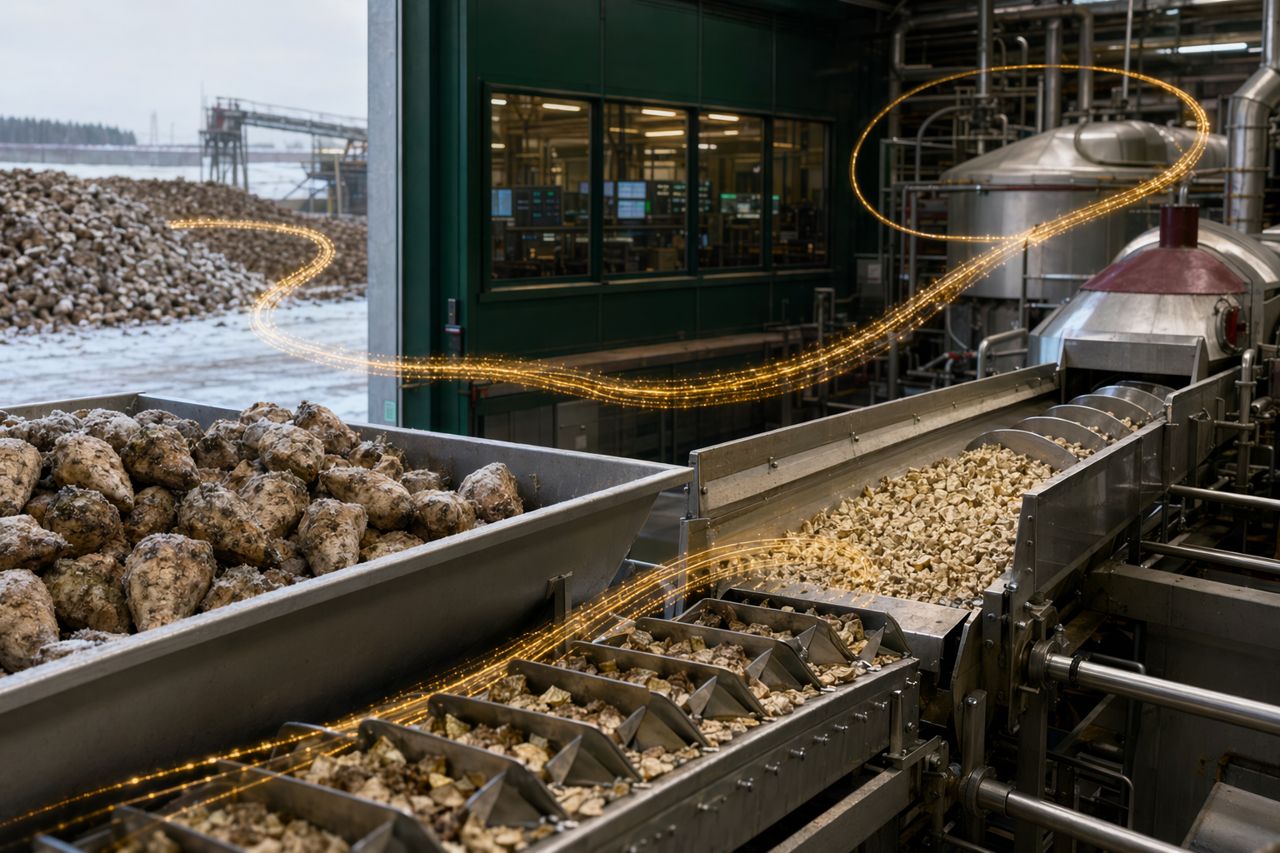
Frozen beet campaigns are rarely uniform. A pile can look stable at the surface while thaw pockets, bruised roots, and microbial activity are already changing what enters slicing, diffusion, purification, evaporation, and crystallization.
For a sugar beet factory, the practical issue is not only beet quality. It is decision timing. Frozen and thawed beet material can alter juice viscosity, increase soluble impurity load, disturb clarification behavior, and raise dextran-related risk before the factory sees the full impact in filtration, heat transfer, or pan floor performance.
Enzymeschoice supports factories that need controlled, campaign-ready enzyme strategies for these variable conditions. As an enzyme supplier for sugar beet processing, our focus is predictable application, process fit, and measurable operating stability across changing beet condition.
Why frozen beets change the process conversation
Freezing damages beet cells. Thawing opens pathways for leakage, microbial growth, and accelerated deterioration. When deteriorated material enters the process, the factory may see changes that move through the entire house:
- Cossettes can release more non-sugar material into diffusion juice.
- Diffusion juice can become more difficult to heat, screen, and clarify.
- Pectin-related viscosity can increase hydraulic drag in juice handling.
- Dextran risk can rise where damaged beet and microbial activity overlap.
- Carbonation and filtration can become less predictable.
- Evaporation and crystallization can feel slower, less sharp, and more sensitive to small changes.
The effect is cumulative. A brief period of poor beet condition may not stop the factory, but repeated pockets of deteriorated beet can push pressure differential, turbidity, mud volume, color, and viscosity in the wrong direction.
Dextran risk is a campaign management issue, not only a lab issue
Dextran is often discussed as an analytical result, but in a beet factory it becomes operational when it affects flow, clarification, filtration, evaporation, and crystallization behavior.
Frozen beet deterioration can create conditions where dextran-forming microbial activity becomes more likely, especially when damaged roots warm, sit, and then enter processing in uneven waves. The factory may not experience the issue as a single clear event. It may appear as a set of symptoms:
- Thickened juice behavior at similar dry substance levels.
- Slower filtration or increased filter aid demand.
- Clarification instability after beet supply changes.
- Higher pressure build-up in screens, lines, or filtration equipment.
- Less predictable pan boiling response.
- Syrup handling that feels heavier than expected.
The key decision is whether the campaign should be managed reactively, after instability appears, or proactively, when beet condition and process indicators suggest rising risk.
Pectin and dextran do not behave the same way
Frozen beet deterioration can create overlapping viscosity problems, but not every viscosity problem has the same cause.
Pectin-related effects often come from beet tissue breakdown and soluble plant material entering the juice stream. Dextran-related effects are associated with microbial polysaccharide formation under suitable deterioration conditions. Both can affect flow and separation, but their process signatures and treatment logic are different.
For factory teams, this distinction matters because enzyme selection and dosing logic should fit the dominant constraint. A campaign may need support for pectin-driven viscosity, dextran-related flow effects, or both, depending on beet condition, storage history, temperature shifts, and observed process behavior.
What process managers should watch during frozen beet campaigns
A practical monitoring view should combine beet yard observation with factory indicators. Useful signals include:
Beet supply and slicing
- Visible thawed zones or wet pockets in stored beet.
- Increased root breakage, rot, or softness.
- Variable cossette quality from one delivery window to the next.
- More fines or damaged tissue entering diffusion.
Diffusion and raw juice
- Changes in raw juice viscosity or pump load.
- Reduced diffusion efficiency at otherwise familiar settings.
- More difficult screening or increased suspended material.
- Unstable draft behavior when beet condition changes.
Purification and filtration
- Slower settling or less compact mud behavior.
- Rising filtration resistance.
- Shorter filter cycles.
- Clarified juice that remains less bright or more variable.
Evaporation and crystallization
- Syrup that handles heavier than expected.
- Reduced heat transfer consistency.
- More cautious pan operation due to viscosity or impurity load.
- Crystal growth that becomes less predictable during poor beet windows.
These indicators do not prove one cause by themselves. They help define when the factory should escalate from normal campaign operation to a targeted enzyme support plan.
Where enzyme treatment fits
Enzyme use in frozen beet campaigns should be positioned as a process control tool, not a last-minute rescue. The objective is to reduce the operational impact of specific soluble polysaccharide challenges before they create avoidable bottlenecks.
A well-designed enzyme plan can support:
- More manageable juice viscosity.
- Better flow behavior through lines, screens, and filtration steps.
- More consistent clarification response during variable beet intake.
- Reduced disruption from pectin and dextran-related process effects.
- More predictable dosing decisions across changing campaign windows.
The correct approach depends on the factory layout, temperature profile, residence time, addition point, juice condition, and the dominant deterioration pattern. A beet factory running a severe thaw campaign will not need the same strategy as a factory seeing short, intermittent pockets of damaged beet.
Why predictable dosing matters
Frozen beet campaigns create variation. Enzyme dosing should not add more uncertainty.
Enzymeschoice designs recommendations around factory realities: where the enzyme can be introduced, how quickly it can contact the target stream, what temperature window is available, and which process measurement will confirm whether the program is helping.
For many factories, the most useful dosing plan includes:
- A baseline campaign dose for elevated-risk beet.
- A response dose when deterioration indicators increase.
- A reduction logic when beet quality improves.
- Clear operator guidance for addition point, timing, and observation.
- A review loop using filtration behavior, viscosity trend, clarification response, and throughput constraints.
This approach gives the production team a controlled operating lever instead of a vague emergency treatment.
Decision framework for a frozen beet enzyme campaign
Before selecting an enzyme program, the factory team should define the operating problem clearly.
1. Is the main constraint flow, clarification, or crystallization?
If the factory is losing capacity through filtration or juice handling, the enzyme plan should target the upstream cause of viscosity and separation resistance. If crystallization is the main concern, the focus may shift toward syrup behavior and impurity impact.
2. Is the problem continuous or appearing in waves?
Frozen beet deterioration often arrives unevenly. A variable intake pattern may require responsive dosing rather than one fixed setting for the entire campaign.
3. Are pectin effects, dextran effects, or both suspected?
Different polysaccharide challenges require different enzyme logic. The strongest program is built around observed process behavior and beet condition, not a generic label.
4. Where can the enzyme actually work?
An enzyme addition point must provide contact, mixing, and a suitable process window. A technically correct enzyme is less useful if it is added where it cannot interact effectively with the target material.
5. What will operators use to judge performance?
Good campaign support should define practical review points: pressure trend, filtration cycle length, juice clarity, viscosity behavior, evaporator response, pan handling, or throughput stability.
Common factory mistakes during frozen beet deterioration
Waiting for the pan floor to show the problem
By the time crystallization becomes difficult, the issue may have already moved through diffusion, purification, and evaporation. Earlier intervention is usually more controllable.
Treating all viscosity as the same issue
Pectin and dextran challenges can overlap, but they are not interchangeable. A precise diagnosis improves enzyme selection and dosing logic.
Changing too many process variables at once
When lime, carbonation, temperature, draft, filtration aids, and enzyme dosing are all adjusted simultaneously, it becomes difficult to understand what helped. A controlled enzyme plan should fit into the factory’s decision sequence.
Using a fixed dose through a changing beet supply
Frozen beet campaigns move. Dosing should be steady enough for operators to trust, but flexible enough to reflect thaw intensity and process response.
How Enzymeschoice supports sugar beet factories
Enzymeschoice works with sugar beet factories that need enzyme programs aligned to campaign conditions, not generic catalog language. We help teams connect beet deterioration, pectin load, dextran risk, viscosity behavior, filtration response, and dosing control.
Our work is built for process managers who need answers such as:
- Which enzyme approach fits the current beet condition?
- Where should dosing be introduced for practical contact time?
- How should the dose change when thawed beet pockets increase?
- Which factory indicators should confirm improved stability?
- How can enzyme use be integrated without disrupting normal operating discipline?
The goal is not to overpromise. The goal is to give the factory a clear, technically grounded option when frozen beet deterioration starts to influence throughput and separation behavior.
Request a quote for campaign-ready enzyme support
If your factory is planning for frozen beet intake, managing thaw-related deterioration, or seeing viscosity and filtration instability during campaign, Enzymeschoice can help define an enzyme support plan for your process conditions.
Request a quote through the on-site form and include your beet condition, main process constraint, intended addition point, and current operating symptoms. Our team will respond with a practical recommendation for your factory review.